
Reading a list of cosmetic ingredients often feels like deciphering an administrative form in a foreign language. Choosing sustainable and effective beauty treatments for your skin requires comparing specific criteria: composition, certification, type of packaging, suitability for skin type. This article reviews the verifiable indicators that separate a truly sustainable product from mere marketing talk.
Organic and natural cosmetic labels: what each certification really guarantees
Not all labels cover the same requirements. Before comparing creams or oils, it’s essential to know what each certification checks and what it leaves out.
| Label | Natural ingredients (minimum) | Organic ingredients (minimum) | Regulated packaging | Animal testing prohibited |
|---|---|---|---|---|
| Cosmos Organic (Ecocert) | Yes (high threshold) | Yes (high threshold for plant-based) | Recommendations, no strict obligation | Yes |
| Natrue | Yes (3 levels) | Variable depending on the level | Not specifically | Yes |
| Slow Cosmétique (mention) | No single quantified threshold | Valued but not mandatory | Evaluated in the overall score | Yes |
| Vegan (various labels) | Not guaranteed | Not guaranteed | Not regulated | Yes (depending on the label) |
A product labeled Cosmos Organic requires a high percentage of natural origin ingredients and a minimum threshold of organic raw materials. The Slow Cosmétique mention also evaluates the overall approach of the brand (sober marketing, consistent pricing) without setting a unique threshold on composition.
A product stamped “vegan” guarantees the absence of animal-derived materials, but a vegan label says nothing about naturalness or packaging. Cross-referencing two criteria, such as Cosmos Organic and a refillable packaging policy, provides a more reliable image than relying on a single pictogram.
To delve deeper into the sustainability of creams on Stylissima, the intersection between certification and skin type remains the most solid starting point.
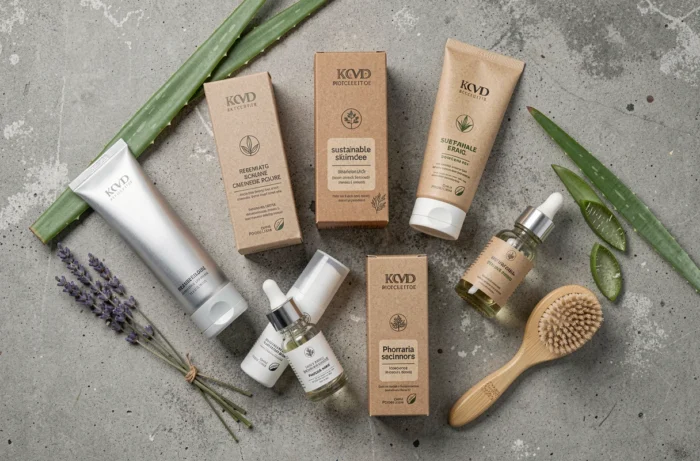
Environmental claims in cosmetics: spotting greenwashing on the label
French and European regulations increasingly govern environmental claims. A brand that displays “eco-friendly” or “carbon neutral” without verifiable proof is exposed to lawsuits for misleading business practices.
The European directive on environmental claims targets vague formulations. A mention like “planet-friendly” without precise proof has no regulatory value. For consumers, the practical rule is simple: look for a precise claim (for example, “100% recycled glass bottle”) and check if a certification or technical data accompanies it.
Added microplastics: different deadlines depending on the type of product
The European restriction on intentionally added microplastics in cosmetics does not apply uniformly. Rinse-off products (shower gels, shampoos) and leave-on products (creams, serums) have different compliance deadlines. Makeup, lip products, and nail products have even different deadlines.
A “microplastic-free” mention does not guarantee the absence of any synthetic particle in the formula. It may simply mean that the product complies with the deadline applicable to its category. Checking the INCI list remains the most reliable action to identify residual synthetic polymers.
Refillable or recyclable packaging: comparison criteria for your facial care
Refillable packaging has a positive image, but its actual sustainability depends on the complete system.
- The reduction of material through refills must be significant: if the refill uses almost as much plastic as the original container, the environmental gain remains marginal.
- The effective recyclability of components is as important as the promise. A glass bottle with a mixed plastic pump poses a sorting problem if the pump is not detachable.
- The protection of the formula also plays a role: some cosmetic actives (vitamin C, retinol) degrade in light or when exposed to air. An opaque and airtight packaging preserves the effectiveness of the treatment, even if it is less photogenic than a transparent glass jar.
European regulations distinguish reuse obligations based on product categories. Cosmetics are not subject to the same reuse rules as food packaging. Comparing two brands on this criterion requires checking if the refill is genuinely available in the usual distribution circuit.

Composition and skin type: adapting sustainable care to real needs
A sustainable product poorly suited to the skin type remains a poor choice. Composition takes precedence over the label when it comes to effectiveness.
Dry skin and organic vegetable oils
Dry skin lacks lipids. An organic vegetable oil (argan, jojoba, avocado) provides fatty acids that strengthen the skin barrier. The indication “of natural origin” on the bottle describes a composition characteristic, not proof of effectiveness. Only the nature of the fatty acids and their compatibility with the hydrolipidic film determine the result.
Oily skin and non-comedogenic natural cosmetics
Oily skin produces excess sebum. Choosing a natural treatment does not exempt one from checking its comedogenicity index. Some vegetable oils (coconut, wheat germ) are comedogenic despite their organic origin. Others (jojoba, hazelnut) regulate sebum without clogging pores.
Sensitive skin: the INCI list as the main filter
For reactive skin, a short list of ingredients is a more useful indicator than the label. The fewer components a product contains, the lower the risk of allergic reaction. Favoring a facial cream with fewer than fifteen ingredients reduces the likelihood of irritation, whether the product is certified organic or not.
Choosing sustainable and effective beauty treatments relies on three concrete checks: certification (and what it truly covers), composition read on the INCI list rather than on front marketing, and the suitability between skin type and formula. The most discriminating criterion remains the INCI list: it is the only mandatory, standardized, and comparable document from one product to another.