Accompanying a child on a daily basis requires time, attention, and reliable benchmarks. Between recommendations on screens, new legal provisions regarding parental leave, and managing parental fatigue, the parameters to consider have significantly evolved in recent years. This article measures the concrete impact of these changes on family organization.
Birth Leave 2026 and Parental Time: What the Numbers Change
Since July 1, 2026, the additional birth leave allows each parent to add one to two months of paid leave after maternity, paternity, or adoption leave. This right is personal and non-transferable, meaning that a couple can accumulate up to four months of presence with the infant.
Compensation is covered by Social Security: 70% of net salary for the first month, 60% for the second, within the limit of the current ceiling. The system is part of the “1,000 first days” policy and explicitly aims to rebalance the sharing of parental tasks.
| Parameter | Before July 2026 | Since July 2026 |
|---|---|---|
| Cumulative Duration (couple) | Variable depending on existing leave | Up to 4 months thanks to additional leave |
| Nature of the Right | Shareable depending on the case | Personal and non-transferable |
| Compensation (month 1 / month 2) | Not applicable | 70% / 60% of net salary |
| Stated Objective | – | Rebalancing parental sharing |
This legal change has a direct consequence: parents now have a wider window to establish daily routines (sleep, feeding, interactions) without the pressure of an immediate return to work. To delve deeper into these topics, parenting advice on Parlons Enfance addresses many concrete situations related to these early months.
Screens and Children: Recent French Guidelines vs. Actual Practices
The French recommendations published in 2024 by a group of experts mandated by the State have set more precise thresholds than previous guidelines. The guiding principle remains the same (limit early exposure), but the nuances have evolved.
What the 2024 Recommendations Say
The framework distinguishes several age groups with progressive thresholds. Emphasis is placed on the nature of the content, the context of use (alone or accompanied), and the cumulative duration throughout the day. Passive exposure before three years remains discouraged, regardless of the type of screen.
However, from the age of three, accompanied and limited use is considered acceptable, provided that an adult is present to contextualize what the child sees.
The Gap Between Guidelines and Practices
Several recent European studies highlight that children’s actual exposure far exceeds the recommended thresholds, even in informed households. The gap is not due to a lack of parental will but to the very structure of the day: commutes, meal preparation, remote work.
- Before three years, many children are exposed to screens during transition moments (meals, dressing), often out of logistical necessity rather than educational choice.
- The link between screen exposure and sleep disruption in children under six is documented by several studies, particularly concerning blue light in the evening.
- The recommendations stress that removing screens is not the goal; framing their use is: duration, time of day, presence of an adult.
The tipping point often occurs at bedtime. A screen used in the hour before sleep measurably disrupts falling asleep. Moving this exposure earlier in the day can sometimes improve sleep quality without changing the total duration of use.
Parental Burnout: Identifying Signals Before Exhaustion
Parental burnout is not a vague concept. It is distinguished from ordinary fatigue by three dimensions identified by research: physical and emotional exhaustion related to the role of parent, emotional detachment from the child, and a feeling of loss of effectiveness in the parental function.
These three dimensions appear together, not in isolation. A tired parent is not in burnout. A parent who accumulates chronic fatigue, emotional detachment, and constant doubt about their ability to raise their child is in a risk zone.
Documented Aggravating Factors
The mental load related to daily logistics (medical appointments, activities, meals, homework) disproportionately weighs on one parent in the majority of family configurations. The additional birth leave mentioned earlier attempts to correct this imbalance at the source, but its effect remains limited to the first months of life.
- The social isolation of the primary parent (lack of family or friendly support) is a major aggravating factor.
- Constant comparison with other parenting models, amplified by social media, fuels feelings of inadequacy.
- Cumulative sleep deprivation over several months degrades emotional regulation abilities, creating a vicious circle with the child.
Asking for help is not a sign of failure but a lever for prevention. Parenting support systems (PMI, associations, specialized consultations) exist precisely to intervene before the situation deteriorates.
Daily Routines: What Works According to the Child’s Age
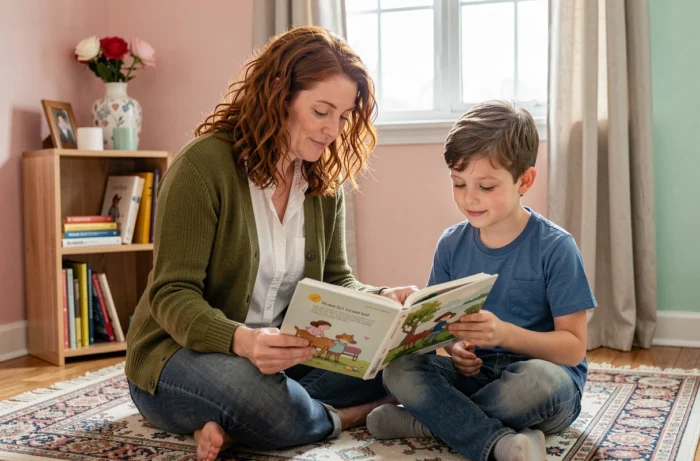
The notion of routine reassures the child because it makes their environment predictable. Studies on cognitive development show that repeating identical sequences (waking up, meals, play, bedtime) reduces anxiety and facilitates the acquisition of autonomy.
Before three years, the regularity of sleep and meal times takes precedence over everything else. A one-hour shift in bedtime can be enough to disrupt the following day. After three years, the child can actively participate in the routine: choosing their clothes, setting the table, putting away a toy. Offering limited choices reinforces the feeling of control without creating decision overload.
The difficulty is not in designing a routine, but in maintaining it when adult constraints (work hours, unforeseen events) disrupt it. Accepting that a routine works four days out of five is already a solid result. Approximate regularity is preferable to a complete lack of structure.