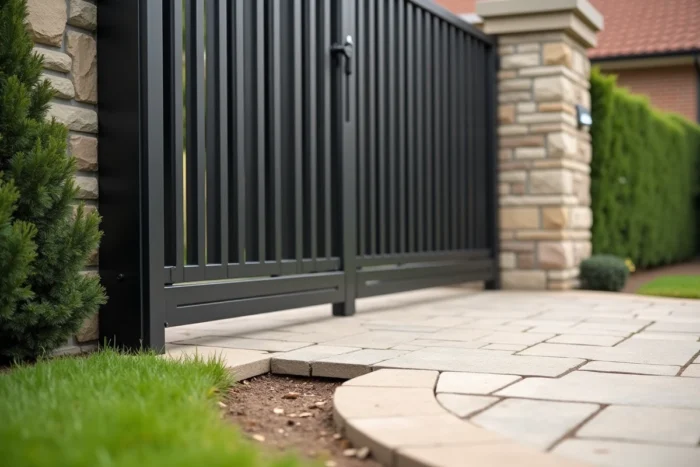
A swinging gate that opens without any visible arm or rail is the result of an underground motorization. The mechanism, housed in a foundation box beneath each pillar, operates the leaves via a hydraulic or electric actuator connected to a mounting bracket. On paper, the solution combines discretion and robustness. In practice, it involves heavy masonry work and a budget significantly higher than traditional automation.
Soil Constraints and Water Management Around the Underground Box
It is rarely the starting point, and that is a mistake. The first criterion for the feasibility of an underground motorization is neither the budget nor the aesthetics, it is the nature of the soil and its ability to drain water. A clayey terrain that retains moisture or a high water table turns the box into a water trap.
Manufacturers now require dedicated drainage around each foundation box. Recent installation manuals provide for a peripheral drain, a bed of graded gravel under the box, and sometimes an inspection well to monitor the water level. Without this system, the risks are real: corrosion of metal components, submerged electronic boards, seals deteriorating within a few seasons.
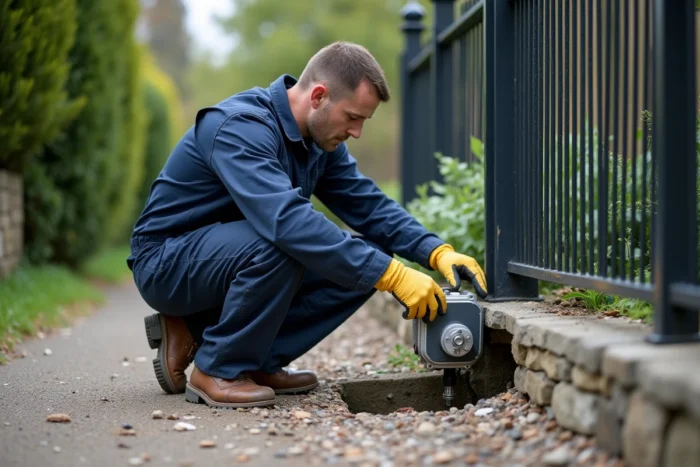
Before any quote, it is recommended to analyze the permeability of the soil. A well-drained sandy terrain rarely poses a problem. A compact soil, waterlogged in winter, can make the installation fragile, even jeopardizing the lifespan of the motor.
Feedback on this point varies by region: in the south, drainage is often minimal, while in wet plain areas, it represents a significant construction task. Understanding the strengths and weaknesses of underground motorization allows for informed decisions before pouring the first slab.
Underground Motorization and Standard NF EN 12453: What the Installer Must Guarantee
Regulations govern all gate motorizations, but underground systems add a layer of complexity. The NF EN 12453 standard, which regulates the safety of use for powered doors and gates, applies fully. The Machinery Directive also requires CE marking and a documented risk analysis by the installer.
In practice, this translates into several obligations:
- Limitation of crushing and shearing forces on the leaves, measured during commissioning.
- Installation of reliable obstacle detection devices (photoelectric cells, motor torque control) to prevent any pinching or crushing.
- Preparation of a technical file and a maintenance log with formalized periodic verification procedures.
The installer assumes legal responsibility for the compliance of the entire system. An individual who installs an underground motorization themselves without adhering to these obligations exposes themselves to liability in the event of an accident. This point is rarely highlighted in commercial content, but it weighs heavily in the choice between professional installation and self-construction.
Durability and Maintenance of an Underground Motor for a Swing Gate
The longevity argument is often cited to justify the extra cost of underground automation. The mechanism, protected from shocks, vandalism, and direct weather, experiences less mechanical stress than an articulated arm exposed to wind and rain.
The reality on the ground is more nuanced. A poorly drained box ages faster than a properly installed articulated arm. The watertightness of the box remains the critical point. If water stagnates, corrosion attacks the moving parts and the electronics. An intervention on an underground motor is also more cumbersome than replacing an arm: sometimes the slab must be broken to access the mechanism.
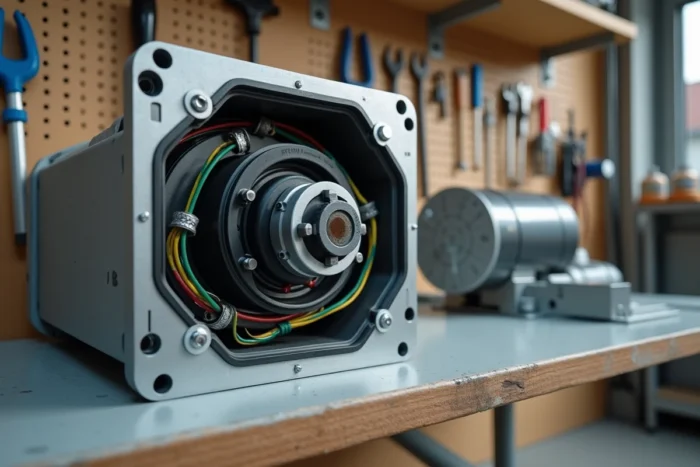
To limit interventions, annual maintenance is recommended, which includes:
- Checking the water level in the inspection well (if it exists) and cleaning the peripheral drain.
- Checking the play of the mounting bracket and lubricating the pivot points.
- Testing the obstacle detection cells and measuring the pushing force of the leaves.
- Visual inspection of the box seals and replacement if necessary.
A well-maintained system in suitable soil lasts well over a decade. However, neglecting drainage or skipping checks significantly reduces this lifespan.
Heavy Swing Gate or Large Width: When Underground Becomes the Right Choice
An underground motorization is not installed by default. This system makes the most sense in specific configurations. A heavy swing gate (leaves made of wrought iron, solid wood, or reinforced aluminum) puts significant stress on the articulated arms, which eventually wear out at the attachment points on the pillars.
The underground actuator, anchored in the slab and directly connected to the leaf via the bracket, distributes the effort differently. The force is applied from the base of the gate, which reduces stress on the hinges and pillars. For wide leaves, this opening geometry is also more stable than an arm pulling from the top of the leaf.
The other common use case is the lack of space behind the pillars. When the property line is close to the gate, no articulated arm can deploy correctly. The underground motorization, invisible and compact, solves this problem without compromising the opening angle.
The extra cost associated with masonry work and the system itself is justified in these situations. For a standard lightweight aluminum gate with enough space behind the pillars, an arm automation remains simpler to install, cheaper, and just as reliable. The choice depends on the terrain configuration, not on aesthetic preference.