
Watering your tomatoes with milk is a tip that has been circulating on gardening forums for years. The promise: to strengthen the plants, provide calcium, and combat diseases. The concrete results are more nuanced than most recommendations suggest. What do we actually measure when we pour diluted milk at the base of a tomato plant, and what should we compare this practice to in order to judge its usefulness?
Milk on tomatoes: antifungal effect versus fertilizing effect
Milk is often presented as a versatile remedy in the vegetable garden. In practice, its two supposed uses (antifungal and fertilizing) are not equal at all. The table below summarizes what can be reasonably expected from each use.
| Use | Application Method | Documented Effect | Limitations |
|---|---|---|---|
| Antifungal (powdery mildew, downy mildew) | Foliar spraying (diluted milk on leaves) | Partial reduction of powdery mildew on certain cucurbits and solanaceous plants | Ineffective against true downy mildew (Phytophthora infestans), which requires copper-based treatments |
| Fertilizer / deficiency corrector | Watering at the base (diluted milk in water) | Marginal supply of calcium and organic nitrogen | The calcium in milk does not correct a soil deficiency related to irregular watering |
The distinction between these two uses is rarely made clear in content that recommends “putting milk at the base of tomatoes.” Spraying on the leaves and watering at the base have neither the same objective nor the same result.
To better understand the dosage of milk for watering tomatoes, one must first identify which of these two effects is being sought, as the concentration and method change everything.
Blossom end rot of tomatoes: why milk at the base solves nothing
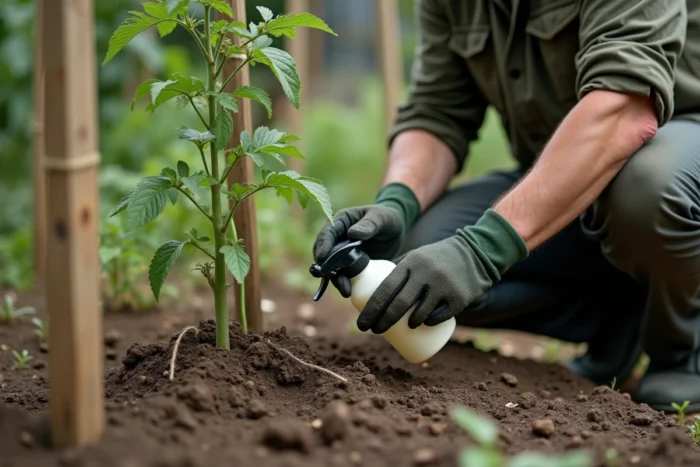
Blossom end rot (apical necrosis) is the most commonly cited problem to justify the use of milk in the vegetable garden. The reasoning seems logical: milk contains calcium, blossom end rot is a calcium deficiency, so milk should correct the problem.
This reasoning is false. Blossom end rot arises from a calcium absorption defect, not a lack in the soil. Irregular watering prevents the plant from transporting calcium to the fruits, even when the soil contains enough. Pouring milk at the base does not improve this transport.
A recent gardening outreach video describes milk as a “false good idea” against blossom end rot, specifying that the real lever is the consistency of watering and soil moisture management. This point deserves further exploration, as it changes the priority of action in the garden.
Real levers against apical necrosis
- Maintain regular and deep watering at the base of the plants, without alternating between drought and excess water
- Mulch the soil to a sufficient depth to limit evaporation and stabilize moisture
- Avoid hoeing too close to the shallow roots, which disrupts mineral absorption
An effective mulch reduces blossom end rot more than any milk solution. It is the consistency of moisture that allows the calcium present in the soil to reach the fruits.
Foliar spraying of diluted milk: realistic conditions and dosage
If the use at the base is questionable, foliar spraying against powdery mildew has more observed results by gardeners. The principle relies on the proteins in milk, which create an unfavorable environment for the fungus to develop on the surface of the leaves.
The commonly used dilution is one part milk to nine parts water. Beyond this, unabsorbed milk ferments on the leaves and attracts other pathogens. Below this, the effect is too weak to be noticeable.
Precautions to take when spraying
- Spray early in the morning, when the leaves are still fresh and the sun is not likely to burn the wet foliage
- Use skimmed or semi-skimmed milk to limit greasy residues that promote mold
- Do not treat more than once a week, and only as a preventive measure or at the first signs of powdery mildew
- Do not expect any effect on downy mildew (Phytophthora infestans), which requires a copper treatment allowed in organic farming
Milk does not replace copper treatments against downy mildew. This confusion between powdery mildew and downy mildew is common in online gardening advice, and can lead to crop losses if one relies solely on milk in the face of a downy mildew attack.
Milk in the vegetable garden and water stress: a question of priority
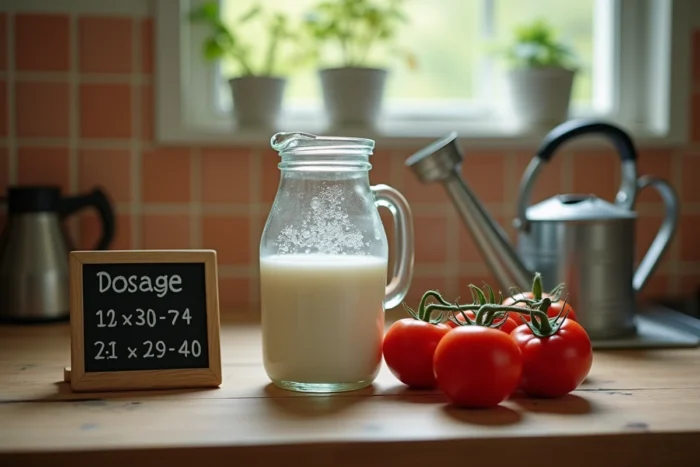
Increasingly frequent heatwaves change the game for tomato cultivation. Recent recommendations on managing the vegetable garden during periods of high heat emphasize three axes: deep and regular watering at the base, thick mulching, timing of watering. Milk is not included.
In conditions of water stress, adding milk to the watering water poses a practical problem. The organic matter in milk can ferment in warm, dry soil, attracting insects and emitting odors. The ratio between the volume of milk needed and the benefit obtained clearly favors watering with clear water, well calibrated.
A tomato plant in full production consumes a significant amount of water each day. Diluting milk in this volume amounts to dispersing a negligible amount of nutrients in a large volume of water. The energy invested in good mulching and consistent morning watering yields much more than the addition of milk, regardless of the chosen dilution.
When milk can find its place in the garden
The only use that withstands analysis remains preventive foliar spraying against powdery mildew, on well-watered and mulched plants. It is a complement, not a substitute. Considering it as a fertilizer or a deficiency corrector leads to neglecting the real levers of productivity in the vegetable garden.
Milk is not recognized as an input in organic farming for fertilization or phytosanitary protection. This absence from the organic specifications confirms that its agronomic effectiveness remains limited compared to validated solutions.
A well-structured soil, smooth watering, and appropriate mulching for the season remain the three pillars of an abundant tomato harvest. Milk, at best, remains a supplementary tool against a specific fungus, provided that one does not attribute to it virtues that it does not possess.