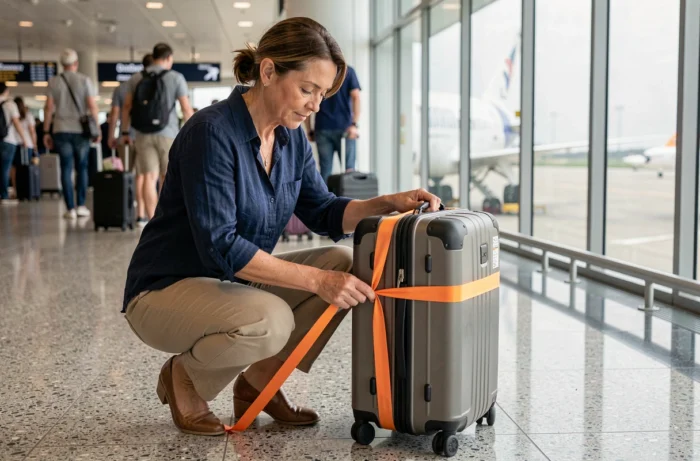
We buckle the suitcase, tighten the strap over it, and at the moment of dropping off the luggage at the check-in counter, doubt sets in: will the staff ask to remove it? The luggage strap is allowed by almost all airlines on checked baggage, but its use is subject to some practical constraints that travelers often discover too late, in front of the baggage carousel.
Straps and automated sorting in baggage: what really gets stuck
The main problem with a poorly placed strap is not regulatory; it’s mechanical. In airports equipped with automated sorting systems, luggage passes over high-speed conveyors. A strap with dangling ends can block the sorting mechanism and cause the suitcase to be diverted for manual inspection.
In August 2026, a baggage handler at Dublin Airport explained to the media that decorations, ribbons, bulky luggage tags, and accessories hanging outside a suitcase disrupt the reading by sorting scanners. The strap falls into this category as soon as it floats or if excess length protrudes.
Specifically, we ensure that the buckle is pressed against the shell of the suitcase and that the free end is folded or tucked under the strap itself. If the strap has a clip system with excess strap, we tuck this surplus into the buckle. Nothing should stick out or hang from the suitcase.

Before putting a luggage strap on an airplane, we also check that it does not cover the barcode label affixed by the agent at the counter. This label is scanned at each stage of the journey in the hold. A strap placed over it makes it unreadable and causes incorrect routing, or even loss of the luggage.
Luggage strap and security check: what the airline can require
No international regulation formally prohibits the strap on checked luggage. In practice, the airline or security agents may ask to temporarily remove it to inspect the suitcase. This is the case during a random check or if the scanner detects suspicious content.
The logic of the checks is based on the triggering of detectors, not on a uniform prohibition of all external accessories. If the strap does not trigger an alarm, it passes without difficulty. But keep in mind that a strap with a non-TSA lock will pose a problem in the United States and in some countries applying similar protocols.
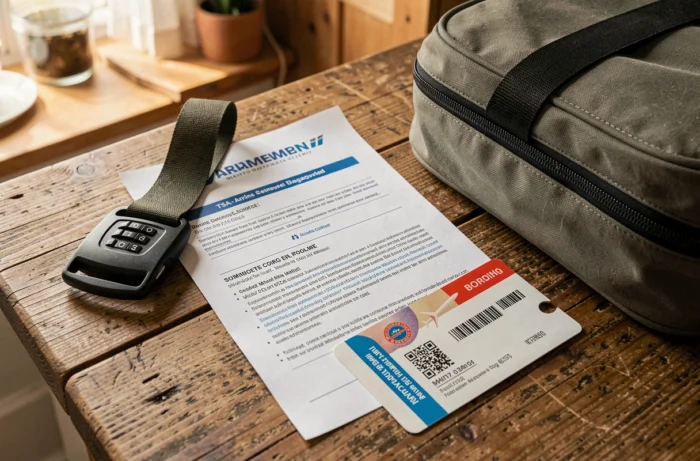
- TSA locks (recognizable by their red diamond) allow security agents to open and close the strap without cutting it. This is the only type of locking compatible with U.S. checks.
- A non-TSA certified code strap will be cut if agents need to inspect the luggage. It will be found cut upon arrival, with no recourse possible.
- A simple strap, without a lock or code, poses no security issue: it can be undone in seconds and reattached after inspection.
On European domestic flights, experiences vary on this point. Some travelers report that their strap was never touched, while others say it was removed during a check and then replaced. Choosing an easy-to-open strap remains the best precaution.
Choosing a strap suitable for air travel
Not all straps are equal for air travel. A strap that is too thin may slip off a hard suitcase with a smooth shell. A strap that is too thick or has a bulky metal buckle may trigger additional examination at the scanner.
The ideal width is between four and five centimeters, sufficient to keep the suitcase closed in case of impact without creating an inconvenient bulge for sorting. The most common material is polypropylene, resistant to abrasion from conveyor belts and moisture in the holds.
Cross strap or simple strap
The simple strap goes around the suitcase in one direction (width or length). It keeps the luggage closed but does not protect against a side opening if the zipper gives way on one side.
The cross strap forms an X on the suitcase, covering both axes. It offers significantly better support on soft suitcases whose zippers are more vulnerable. For hard suitcases with a clip closure, a simple strap is sufficient in most cases.
Bright color and luggage identification
Beyond security, the strap serves to identify your suitcase on the carousel. A brightly colored strap (orange, yellow, red) allows you to spot your luggage from a distance, especially when traveling with a black or gray suitcase, like most passengers.
This identification function is often underestimated. It saves time during retrieval and reduces the risk of another traveler leaving with a suitcase identical to yours.
Common mistakes when strapping your suitcase before a flight
Some habits seem logical but complicate travel:
- Strapping the suitcase over the retracted telescopic handle. If the handle deploys due to a jolt in the hold, the strap tightens and can break the buckle or deform the handle. Position the strap next to the handle, never over it.
- Attaching an additional lock to the strap and another to the zipper. Multiplying locking points slows down checks and increases the likelihood that an agent will cut the strap rather than look for the right key.
- Using plastic wrap in addition to the strap. The wrap can obscure the barcode label and complicate automated sorting, just like a poorly positioned strap. Either one is sufficient; together they create more problems than they solve.
The luggage strap remains a simple and effective accessory to protect your belongings in the hold. Choose it simple in design, tighten it flat against the suitcase, and ensure that the airline label remains visible. The rest is taken care of by the conveyor belts.