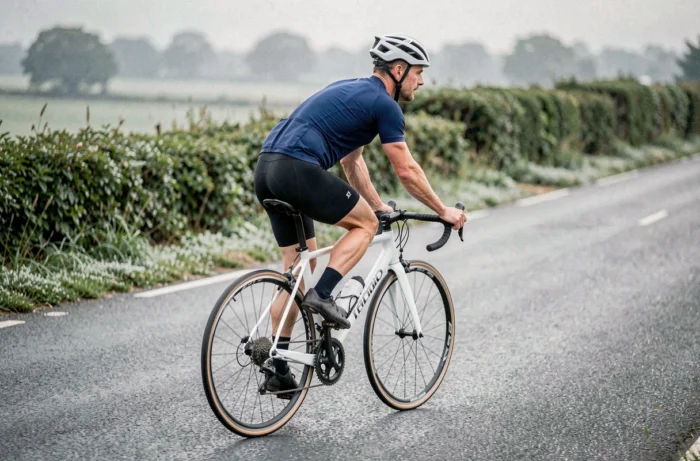
The Triban RC120 is an entry-level road bike designed by Decathlon, built on a 6061 T6 aluminum frame with a carbon fork and a Microshift 2×8 speed drivetrain. This price positioning, among the lowest on the market for a bike with drop handlebars, makes it a natural entry point for discovering road cycling. Comparing this model to its direct competitors requires understanding what each component actually contributes to daily pedaling.
Microshift Drivetrain and Shimano Compatibility: What Changes in Use
Decathlon’s choice to equip the current RC120 with a Microshift drivetrain instead of a Shimano Claris has a direct consequence on the availability of spare parts. Shimano cables, housings, and derailleurs can be found in any bike shop. Microshift components, which are less common in Europe, may require a special order or a visit to a Decathlon store.
On the ground, the difference in precision between a Microshift 2×8 group and a Shimano Claris 2×8 remains modest for a beginner. Both offer sixteen gears covering a range sufficient for flat and rolling terrain. The real divergence appears at maintenance or when replacing a derailleur: an independent workshop will almost always have Shimano in stock, rarely Microshift.
Recent discussions on cycling forums indicate that the current RC120 could be replaced by a version equipped with a Shimano Claris drivetrain at a higher price. This evolution confirms that Decathlon is gradually repositioning its entry-level road offerings towards more standardized components, even if it means increasing the price.
To delve deeper into this point and other technical aspects, a detailed file compares the Triban RC120 versus its rivals across all the criteria that matter at this price level.
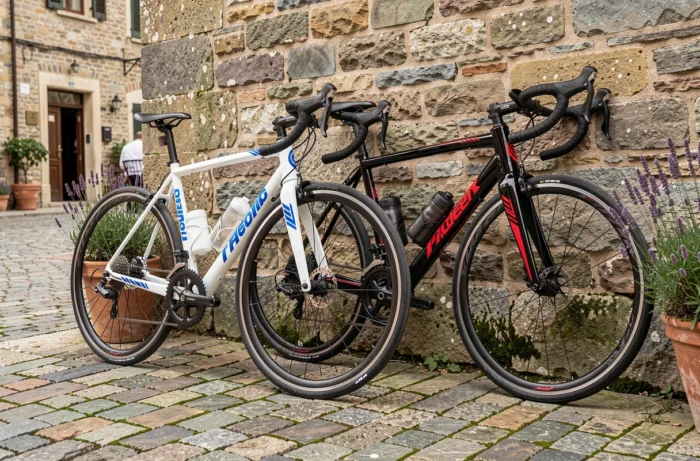
Aluminum Frame and Carbon Fork of the RC120 Compared to Alternatives in the Segment
The combination of an aluminum frame and a carbon fork is not exclusive to the RC120. Several brands offer this architecture on bikes sold between 500 and 700 euros. The carbon fork absorbs some of the vibrations transmitted by the road, reducing fatigue on rides longer than an hour.
The RC120’s 6061 T6 aluminum frame is a common, robust, and relatively lightweight alloy for this price level. Competing alternatives in this range often use the same alloy or a non-heat-treated 6061, with marginal weight differences.
Geometry and Comfort on Long Distances
The geometry of the RC120 favors an upright position, with a generous stack (height of the cockpit) compared to a performance-oriented bike. This choice makes the initial rides less taxing on the back and neck. In return, the aerodynamic position is limited compared to a more racing-oriented frame.
Direct competitors adopt similar geometries, referred to as “endurance” or “comfort.” The difference often lies in the length of the top tube and the head angle, which influence stability at high speeds and maneuverability in the city. On this point, the RC120 proves to be quite stable, suitable for mixed road and commuting use.
Tires and Wheels: The Area Where the RC120 Shows Its Limits
The RC120 comes with 700x28c tires, a compromise between rolling resistance and comfort. Discussions on the r/pedale forum confirm that the frame accepts tires up to 32 mm, which opens the possibility of fitting larger tires for commuting or stabilized paths.
The original wheels are heavy, as is the case with almost all bikes in this segment. This is the first area to improve for gaining liveliness and rolling comfort. A lighter set of wheels radically transforms the bike’s behavior, but represents an investment that can exceed a third of the price of a new bike.
- Original 700x28c tires, frame compatibility up to 32 mm for greater versatility
- Low-profile, heavy but sturdy wheels, typical of entry-level
- No original provision for tubeless tires (rims not compatible without modification)
- Competitors at the same price share this same weakness regarding wheels

RC120 or GRVL 120: Choosing Between Road and Gravel at Decathlon
The question frequently arises in forums: should you choose the road-oriented RC120 or the gravel-oriented GRVL 120? Both share a similar price and an aluminum frame, but differ on concrete points.
The GRVL 120 comes with wider tires, has an even more upright geometry, and accepts fenders and racks without modification. The RC120, on the other hand, rides faster on asphalt thanks to its thinner tires and slightly tighter geometry.
The choice depends on the dominant surface: if more than half of the rides are on the road or in the city, the RC120 remains the most suitable. If towpaths, greenways, or forest trails represent a regular part of outings, the GRVL 120 offers more leeway.
Upgrading: Van Rysel Instead of Triban
Since the reorganization of Decathlon’s brands, the natural progression after an RC120 no longer goes through another Triban but through the Van Rysel EDR or NCR range. The RC120 retains its role as a discovery bike, without a true successor in the same family.
This clarification has a practical impact: buying an RC120 today means choosing a bike for learning and regular riding, without the prospect of incremental upgrades within the Triban range. Upgrading means changing bikes, not just components.
The RC120 fulfills its role for a cyclist who is starting out or looking for a second bike dedicated to commuting. Its limitations, concentrated on the wheels and the Microshift drivetrain, are shared by the entire segment. The real question before purchase is not whether this bike is good for its price, but whether the intended use justifies staying at this budget level or aiming directly for a step up.