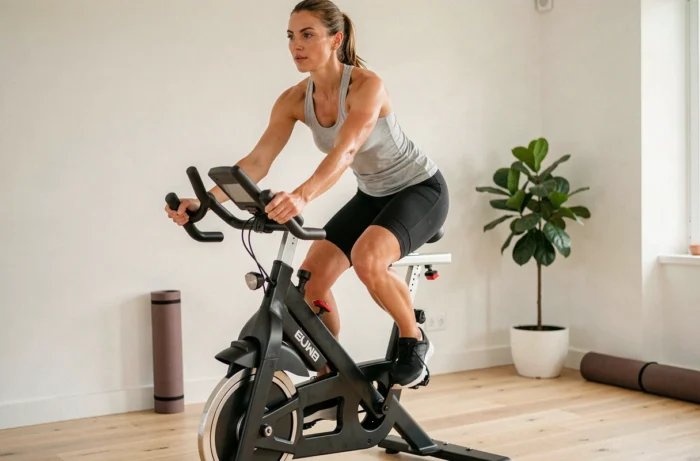
The Sportstech SX200 is one of the most recommended spinning bikes in the mid-range category. Its technical specifications highlight a generous flywheel and a silent belt drive. Online reviews agree on the mechanical quality of the whole, but one aspect remains consistently underestimated: the actual cost of use once the bike is connected to an ecosystem of applications.
This gap between the mechanical promise and the connected experience deserves closer examination, as this is where the long-term relevance of this model is at stake.
Actual connected usage cost of the Sportstech SX200: beyond the purchase price
The product sheet for the SX200 mentions Bluetooth compatibility and the possibility of connecting the bike to a smartphone app. On paper, this is a selling point. In practice, the cost of use depends on the chosen software ecosystem, not just the bike itself.
The market for connected training devices is now marked by recurring subscriptions to access the immersive features of third-party applications. Platforms like Kinomap or Zwift offer video routes, guided workouts, and social features, but these services are not free. A monthly subscription can represent, over a year, a significant portion of the initial purchase price of the bike.
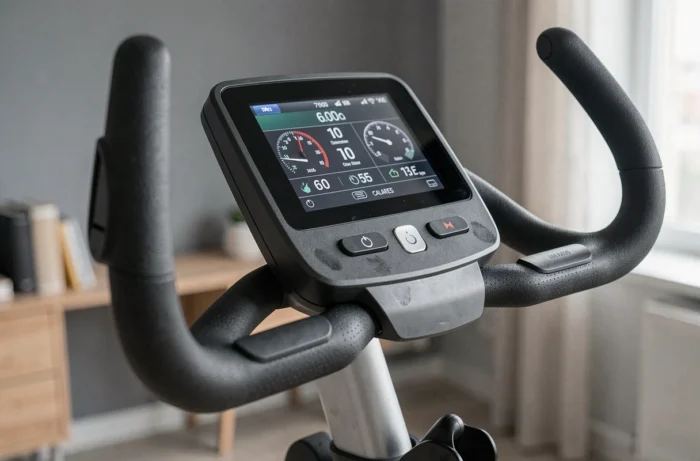
The SX200 does not lock the user into a closed proprietary ecosystem, which is an advantage compared to some high-end competitors. However, its built-in console remains basic (displaying standard effort data), and the motivating experience almost necessarily goes through an external app. Without a subscription, you end up with a solid mechanical bike but lacking the software layer that justifies, for many buyers, the choice of a “connected” model.
Before purchasing, it is therefore relevant to check the actual compatibility with the targeted applications. Strava, for example, lists its compatible devices and applications on its dedicated page, and the level of integration varies depending on the available sensors. For a detailed analysis of the bike’s features, the Sportstech SX200 review on velo-appartement.org details the mechanical performance and ergonomics of the model.
Belt drive and friction resistance: what the SX200’s mechanics are worth
The belt drive system is one of the technical choices that define the SX200. Compared to a chain drive, the belt almost completely eliminates mechanical noise. This is a decisive criterion for apartment use, especially during off-hours.
The 22 kg flywheel ensures a smoother pedaling experience than most traditional stationary bikes in this price range. The movement remains steady even at low cadence, which limits the feeling of “dead spots” at the top and bottom of the pedal stroke.
The resistance works through friction: a felt pad slows down the flywheel via a manual adjustment knob. This system has the advantage of being progressive and mechanical (no power supply needed), but it has a known limitation:
- The felt pad wears out over time and requires periodic replacement, the frequency of which depends on the intensity of use
- A friction noise may appear after several months, correctable by lubricating the contact area between the pad and the flywheel
- The manual adjustment does not allow for precise quantification of the applied resistance, unlike motorized magnetic systems that display a numerical level
The absence of magnetic resistance is the main compromise of this model. For structured training with precise power zones, feedback from users varies on the system’s ability to provide sufficient reproducibility from one session to another.
Ergonomics and adjustments of the SX200: for which body types
The SX200 offers seat (height and depth) and handlebar adjustments that allow for position adaptation to different body types. The maximum supported weight is stated to be 125 kg, placing the bike in a solid category for home use.
The seat is of the spinning type, narrower than a traditional stationary bike seat. This choice favors standing pedaling and intense sessions, but may pose a comfort issue for users planning long sessions at a moderate pace. Replacing the seat with a wider model is possible thanks to the standard mounting system.
The pedals accept toe clips, which secure the foot during acceleration phases. This detail, often overlooked in comparisons, directly contributes to the “indoor biking” pedaling sensation that the SX200 aims to replicate.
Product compliance and documentation: a point to check before purchase
The SX200 is an imported product, distributed in Europe through platforms like Amazon or Decathlon (marketplace). For a fitness device sold in the European Union, the question of product compliance and safety documentation in French arises.
The presence of clear instructions and appropriate labeling for the country of sale is part of the regulatory obligations in force. The available data does not allow for conclusions about any specific shortcomings of the SX200, but this is a criterion to check upon receipt: instructions in French, readable safety information, contact details of the responsible party for the European market.
This point actually concerns all imported connected fitness devices, not just this model.
Friction or magnetic resistance: summary table
| Criterion | Friction (SX200) | Motorized Magnetic |
|---|---|---|
| Noise | Low (slight friction possible) | Almost none |
| Adjustment precision | Progressive but not quantified | Numbered levels |
| Maintenance | Pad replacement | None or very low |
| Power supply needed | No | Yes (mains or self-powered) |
| Session reproducibility | Approximate | Precise |
The Sportstech SX200 remains a solid spinning bike mechanically, with a smooth flywheel and a stable frame. Its true limitation lies not in the quality of construction but in the gap between the connected promise of the product sheet and the reality of use without a subscription. Integrating the annual cost of applications into the total budget helps avoid disappointment that has nothing to do with the bike itself.