
A cocoon of well-being is not just about piling cushions on a sofa. The term refers to an interior layout designed to reduce stressful stimuli (noise, cold light, visual clutter) and promote physical and mental recovery. Transforming your home into such a space relies on concrete choices of materials, light temperature, and furniture arrangement.
Bio-sourced materials and indoor comfort: the link that decor ignores
Articles on the cocooning atmosphere generally recommend faux fur throws and scented candles. They overlook a more structural lever: the choice of covering and insulation materials, which directly affects perceived temperature, acoustics, and air quality.
Since January 1, 2025, the environmental regulation RE 2025 strengthens the use of low-carbon and bio-sourced materials in new construction in France. Wood, rammed earth, wool, plant fibers: these materials naturally regulate ambient humidity and provide thermal inertia that stabilizes indoor temperature.
For renovations, this translates into a wider range of wood fiber panels, lime plasters, or cork coverings. A lime-coated wall absorbs humidity variations much better than standard acrylic paint. Cork, on the other hand, dampens impact noise and maintains a warm surface to the touch, two qualities that contribute to the thermal and acoustic comfort of a living space.
To delve deeper into well-being-oriented interior design solutions, you can explore the Mindtrap website, which gathers resources on the subject.
Light temperature: the setting that changes the ambiance of a room
Light is the most underestimated parameter in a cocooning decor project. The color of a wall or the texture of a fabric changes radically depending on whether it is illuminated with a 2,700 Kelvin bulb (warm white) or a 4,000 Kelvin bulb (neutral white).
Choosing the right temperature for each room
A light around 2,700 K promotes melatonin production in the evening, preparing the body for sleep. In a bedroom or a relaxation-focused living room, this is the range to aim for. In contrast, a workspace or kitchen benefits from staying around 3,500 K to maintain alertness without straining the eyes.
Dimmable LED bulbs allow you to adjust brightness according to the time of day. Paired with lampshades made of natural materials (linen, rattan, paper), they diffuse indirect lighting that eliminates harsh shadows and aggressive reflections.
- Living room and bedroom: warm white bulbs (2,700 K), dimmer switch, multiple low-height sources rather than a single ceiling light
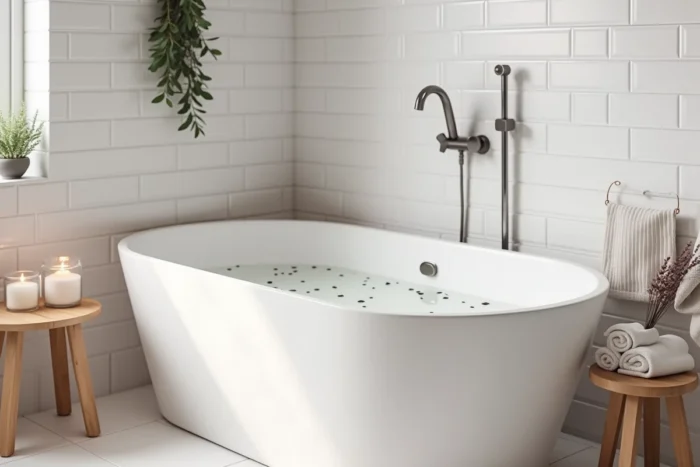
- Bathroom: a main neutral source (3,000-3,500 K) for the mirror, complemented by candles or a warm night light for evening baths
- Hallways and entryways: indirect lighting directed downward, sufficient for moving around without dazzling when exiting a dark room
Biophilic design: integrating greenery without cluttering the space
Biophilic design involves reintroducing natural elements (plants, water, raw materials) into the indoor space to reconnect occupants with their environment. This is not a decorative trend: studies in environmental psychology document a measurable reduction in perceived stress in the presence of indoor vegetation.
The common pitfall is plant overload. Ten poorly placed plants in a small living room create visual clutter that produces the opposite effect of what is sought. Three plants of different sizes, arranged at varying heights (floor, shelf, hanging), better structure the space.
Which plants for which use
Plants with broad, cascading leaves (pothos, philodendron) soften the angles of straight furniture. Succulents and cacti, often recommended for their ease of maintenance, do not provide the same enveloping effect. In a bedroom, a jasmine or a peace lily helps purify the air without requiring abundant direct light.
Curtains and textiles: the little-known role of soft sound insulation
Curtains are often chosen for their color or pattern. However, their acoustic function is crucial in creating a calming interior. A thick fabric curtain reduces sound reverberation in a room, which decreases auditory fatigue, especially in modern homes with smooth walls and hard floors.
A heavy velvet or linen curtain, falling from the ceiling to the floor, absorbs mid-range frequencies (voices, television, open kitchen noises). The effect is comparable to that of a wall acoustic panel, but more discreet. Dark and matte colors (terracotta, sage green, anthracite gray) enhance the feeling of enclosure without excessively darkening the room if the lighting is well calibrated.
- Opt for a sufficiently dense weight to achieve a real acoustic effect, not just decorative sheers
- Double a lightweight curtain with a thermal lining to improve both sound and thermal insulation of the window
- Long or medium-pile rugs complement sound absorption on the floor, especially on parquet or tile
The European regulation ESPR on ecodesign provides for the gradual introduction of a digital product passport, which will inform about the durability and the share of recycled materials in upholstery textiles. In the future, choosing a cocooning curtain or throw by checking its environmental impact will become as simple as reading a food label.
An interior designed as a cocoon of well-being relies more on technical choices than on impulsive purchases. Humidity-regulating materials, light adapted to the circadian rhythm, measured vegetation, acoustically functional textiles: each choice affects a specific sensory parameter. The comfort of a home is built in successive layers, not by accumulating objects.