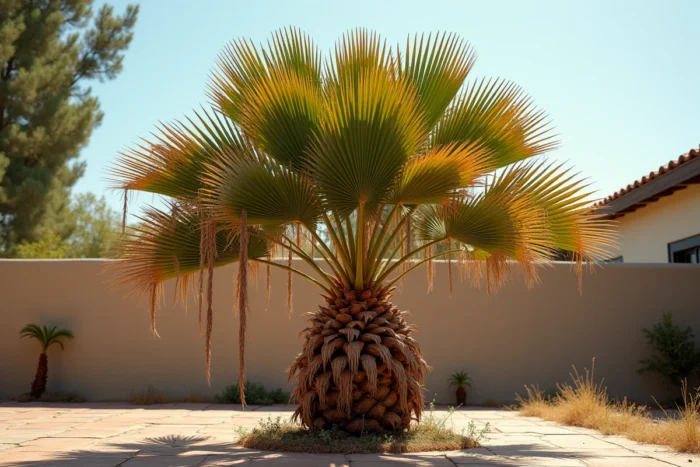
We observe a palm tree from the terrace; its fronds have been browning for a few weeks, and the question arises: simple temporary stress or the beginning of the end? The answer is not always apparent at first glance. Recognizing a dead or declining palm tree requires checking several specific areas of the plant, from the top of the crown to the base of the trunk. Here are the concrete signs to look for before making a decision.
The central spear test: the most reliable diagnosis
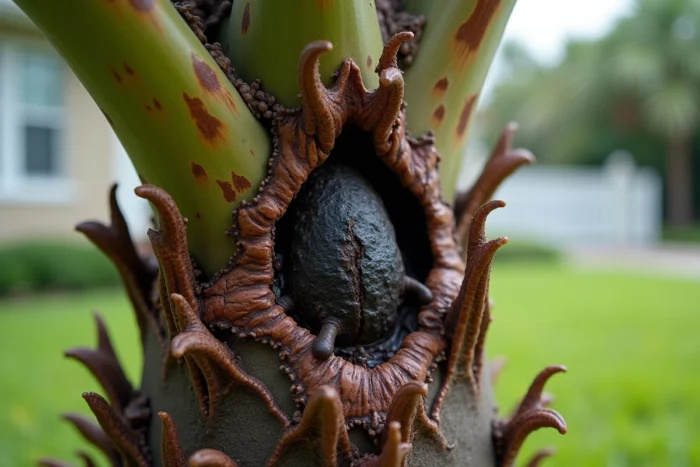
Before even looking at the color of the leaves, we start from the top. The central spear is the young leaf still curled up that emerges from the heart of the palm. In a healthy specimen, it grows straight and resists if we gently pull on it.
If the spear comes out effortlessly, the apical bud is dead. This unique bud controls all the growth of the palm. Unlike a leafy tree, a palm does not regrow from a lateral bud. When the heart fails, the plant is doomed, even if the lower fronds remain green for several weeks.
This test allows us to quickly understand what we are dealing with. To understand in detail how to tell if a palm tree is dead, we always complement it with an examination of the fronds and trunk described below.
Yellowing fronds: locate the affected area on the crown
Yellow leaves on a palm do not automatically indicate a serious problem. It all depends on their position in the crown.
- Lower fronds that yellow and gradually dry out are part of the natural cycle. The palm sheds its old leaves starting from the bottom, just as it would in its native habitat.
- Yellowing of the young fronds located at the top signals a root issue, a nutrient deficiency, or excess water. This sign should never be ignored.
- Randomly distributed yellow fronds throughout the crown suggest more of an overall water stress or substrate problem.
We therefore focus on the top. If the new leaves are already emerging yellow or deformed, the palm is losing its ability to produce chlorophyll where it counts. We are then facing active decline, not a classic renewal.
Asymmetrical or uniform decline: two different paths
A detail that is often overlooked: the way the palm loses its fronds tells us something. Decline affecting only one side of the crown, asymmetrically, may indicate fusarium wilt, a fungal disease that blocks the conducting vessels of the trunk on one side.
Uniform decline, where all fronds wilt at the same rate, suggests more of an overall physiological stress: prolonged lack of water, compacted soil, unsuitable exposure. The distinction is useful because we do not treat the two in the same way.
In the case of advanced fusarium wilt, feedback varies on the chances of rescue. Some specimens respond to early fungicide treatment, while others decline despite care. Observing the symmetry of the decline remains a simple first filter to apply in the garden.
Soft trunk, peeling bark: check the trunk structure
The trunk of the palm is not wood in the classical sense. It is a bundle of compact fibers. When it begins to soften to the touch, especially at the base or top, it is a sign of internal rot that is often irreversible.
Press the base of the trunk with your thumb. In a healthy specimen, the surface is firm and dense. If the finger sinks in or pieces of bark come off easily, the internal tissue is decomposing. This situation often occurs after a wet winter or on palms planted in poorly drained soil.
A trunk that leans unusually without strong winds often confirms the extent of internal damage. At this stage, we consider felling for safety reasons.
Rate of decline and season: a useful framework
The timing of symptom appearance gives an indication of their origin. A rapid decline in spring or summer points to a pest or disease. The red weevil and the Paysandisia moth are active during the warm months, and the damage they cause progresses quickly.
A slow decline, spread over several months without sudden acceleration, suggests more of a cultural problem: insufficient watering, impoverished substrate, too shaded location. This type of decline leaves more room for intervention.
We note the date of the first signs and their rate of progression. A palm that loses all its green fronds within a few weeks between May and September deserves an inspection of the heart for larvae or pest galleries.
Absence of new shoots in spring: the decisive sign
At the beginning of spring, a living palm produces new fronds from its heart. If no growth appears while temperatures have risen for several weeks, it is a strong indicator. Combined with a central spear that detaches and a softened trunk, the absence of new leaves confirms that the palm is dead.
We generally wait until the end of May before making a definitive diagnosis. Some hardy species, like Trachycarpus, restart late after a harsh winter. Cutting too early would be a mistake for a specimen that simply needs time to restart its growth.
The diagnosis of a palm tree relies on a bundle of signs, not on a single isolated symptom. Central spear, location of yellowing, condition of the trunk, symmetry of decline, rate of appearance, production of new leaves: it is the combination of these observations that allows us to determine between a recoverable palm and a lost specimen.