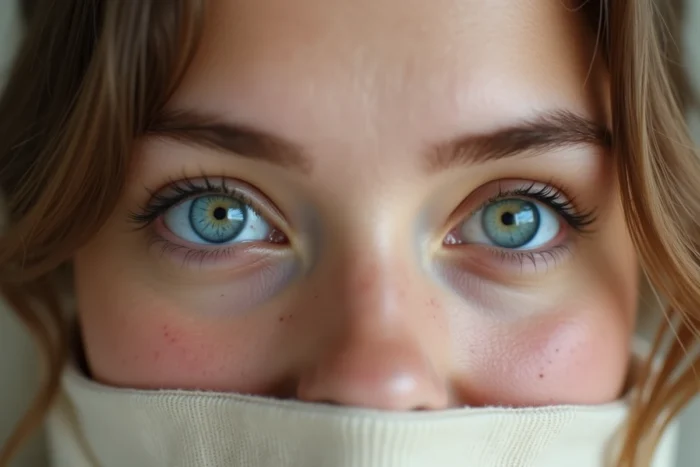
Observing one’s iris closely in a mirror and discovering shades of blue, green, and gray, punctuated by a golden ring around the pupil, often triggers an impulse to search online. The color of the eyes fascinates, but the available answers oscillate between genetic simplifications and pseudo-psychological interpretations. What happens in the iris, however, involves precise optical and biological mechanisms, the medical significance of which remains limited in the vast majority of cases.
Melanin and Light Diffusion: Why the Iris Has No Blue or Green Pigment
No cell in the human iris produces a blue or green pigment. The only coloring molecule present is melanin, which comes in eumelanin (brown) and pheomelanin (yellow-red). The perceived color depends on the amount of melanin in the iris stroma and how light is diffused within it.
A very low melanin iris allows light to pass through the stroma fibers, which preferentially reflect shorter wavelengths. The perceived result is blue, by an effect comparable to that which colors the sky. Add a bit of melanin in the superficial layers, and the blue shifts to green or gray, depending on the density and distribution of the pigment.
The meaning of blue, green, gray, and yellow eyes thus refers less to multiple pigments than to a gradient of melanin interpreted by ambient light. This is also why the same iris can appear blue, green, or gray depending on the lighting: the structure does not change, only the incident spectrum varies.

Yellow Ring Around the Pupil: Central Heterochromia or Warning Signal
The golden or amber ring visible around the pupil has a clinical name: central heterochromia. It indicates a higher concentration of pheomelanin near the pupil than in the rest of the stroma. This phenomenon is common, often present from childhood, and does not in itself constitute a cause for concern.
The distinction to be made is clear. A yellow ring located in the colored part of the iris, stable for years, is a matter of natural pigment variation. In contrast, yellowing of the sclera (the white of the eye) signals an excess of bilirubin in the blood, potentially linked to liver or biliary dysfunction. The two situations have nothing in common medically.
When Color Change Warrants Examination
A recent change in hue in the iris, especially if asymmetric (affecting only one eye), justifies an ophthalmological consultation. Possible causes include:
- A lipid deposit at the periphery of the cornea, called arcus senilis or gerontoxon, which forms a gray or whitish circle around the iris. Common in older individuals, it may raise concern if it appears before the age of fifty.
- The use of certain eye drops, particularly latanoprost (prescribed for glaucoma), which can gradually and sometimes permanently darken the iris.
- An intraocular inflammation (uveitis) or rare pathologies such as Vogt-Koyanagi-Harada disease, which can alter iris pigmentation.
Outside of these specific cases, the presence of a central yellow ring in a light iris is a common anatomical variant.
Eye Color and Personality: What Research Does Not Confirm
Many articles associate blue with serenity, green with creativity, gray with wisdom, or yellow-brown with boldness. These correlations circulate widely, but they rest on fragile foundations.
Recent content addressing this link mentions possible statistical correlations between iris pigmentation and certain behavioral traits. The available data do not allow for a conclusion of causality. The melanin in the iris and brain neurotransmitters share common biochemical precursors, which could explain weak associations in some studies. However, extrapolating a psychological profile from the color of an iris remains speculative.

The risk of these interpretative frameworks is twofold. On one hand, they reduce the complexity of a personality to a single physical trait. On the other hand, they can divert attention from a real issue: what the iris reveals is the density and distribution of a pigment, not a character.
Variable Perception of Light Eyes: Lighting Changes Everything
People with lightly pigmented irises often notice that their eyes “change color” depending on the time of day, the color of their clothing, or the lighting environment. This phenomenon is purely optical.
A low melanin iris acts as a low-density filter. The natural morning light, rich in blue, enhances the blue component of the iris. Warm artificial lighting shifts perception towards green or gray. Wearing a navy blue sweater brings the perceived hue closer to blue through chromatic contrast. None of these changes correspond to a real modification of the iris structure.
This variability also explains why classifying an iris as “blue” or “green” remains subjective. The boundary between these categories does not exist biologically: it is a continuum of pigment density that language arbitrarily divides.
The color of the iris is thus a physical trait determined primarily by genetics, modulated by light, and subject to slight changes with age or specific treatments. Seeking in this color a mirror of personality or a spontaneous medical diagnosis leads to shortcuts that neither optics nor medicine validate.