
Constipation affects a significant portion of the adult population in France, with a clear female predominance. Among the non-drug interventions, the choice of mineral water often comes up in discussions. Not all waters are equal when it comes to this transit issue, and the mineral composition plays a more decisive role than just the volume consumed.
Magnesium and sulfates: the osmotic mechanism that affects transit
The classic advice “drink more water” is not enough to summarize the effect of mineral water on constipation. What matters is the content of magnesium and sulfates.
These two minerals exert a osmotic effect in the intestinal lumen: they draw water into the colon, which softens stools and facilitates their progression. Magnesium also stimulates colonic motility by acting on the contraction of the smooth muscles of the intestine.
A randomized trial published in 2024 in Neurogastroenterology & Motility compared, among 40 healthy adults, a low-mineral water and a magnesium-rich water, at a rate of one liter per day for 14 days.
Participants drinking the magnesium water showed a significant increase in their Bristol stool scale score and an increase in the frequency of spontaneous bowel movements, without an increase in the total volume of water consumed. The effect was indeed due to the mineral composition, not the quantity.
To find out which mineral water to drink for constipation, it is therefore essential to check the label first: the content of magnesium and sulfates takes precedence over the brand name.
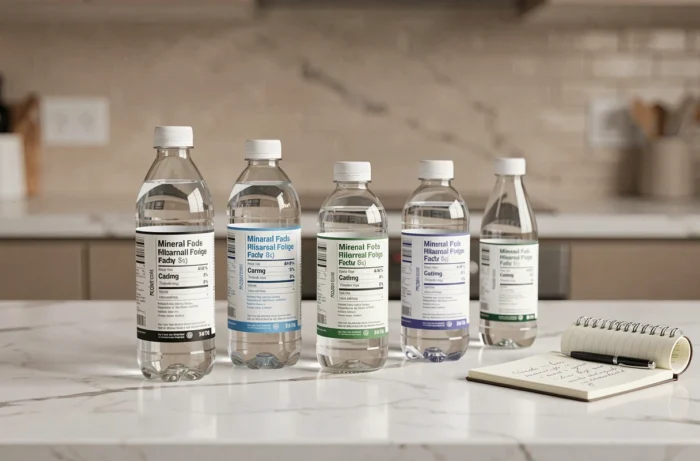
Comparison of magnesium-rich mineral waters available in France
Several waters stand out for their mineral profile suitable for transit. Competitors consistently mention Hépar, but other references deserve to be examined.
| Mineral Water | Magnesium (mg/L) | Sulfates (mg/L) | Particularity |
|---|---|---|---|
| Hépar | 119 | 1,530 | The most clinically studied for transit |
| Courmayeur | 52 | 1,420 | Rich in sulfates, moderate magnesium |
| Rozana | 160 | 230 | Very high in magnesium, carbonated |
| Quézac | 69 | 143 | Carbonated, more balanced profile |
Hépar remains the most documented reference. Its effectiveness on functional constipation has been validated by clinical studies. In contrast, Rozana has the highest magnesium content in the panel, which may interest those seeking an overall magnesium intake.
Taste is a practical factor that should not be overlooked. Hépar has a pronounced flavor related to its high mineralization, which some people find difficult to drink daily. Courmayeur, less loaded with magnesium but very rich in sulfates, offers a compromise for those who struggle with the taste of Hépar.
Daily volume and duration: what the available data says
The question of the necessary volume to observe an effect on transit is divisive. The 2024 trial mentioned above used one liter per day for 14 days, a protocol that produced measurable results even in non-constipated subjects.
Hépar recommends on its website the consumption of one liter daily to contribute to regular transit. This volume corresponds to about two-thirds of the daily water intake recommended for an adult.
Points of caution regarding duration
The available data does not allow for conclusions about the long-term effect of daily consumption of highly mineralized water. Several factors deserve attention:
- Waters very rich in sulfates (Hépar, Courmayeur) may cause digestive discomfort (bloating, overly liquid stools) in sensitive individuals, especially at the beginning of consumption
- An excessive intake of magnesium from water alone remains unlikely at usual doses, but individuals with kidney insufficiency should consult a doctor before changing their habits
- The osmotic laxative effect decreases if the rest of the diet is low in fiber and physical activity, as these factors work in complementarity on colonic motility

Mineral waters and magnesium-based laxatives: a distinction to know
The AGA-ACG recommendations published in 2023 on idiopathic chronic constipation clearly distinguish between magnesium salts used as laxatives (magnesium hydroxide, magnesium citrate) and mineral waters naturally rich in magnesium. The former are dosed to provoke a rapid and clear laxative effect. The latter act more gradually.
This distinction has a practical consequence: a magnesium-rich water does not replace a prescribed laxative treatment. It is part of a foundational approach, complementary to a diet rich in fiber and regular physical activity.
Field reports vary on this point. Some individuals report rapid relief with Hépar, sometimes within the first few days. Others notice no significant change after several weeks. The individual variability in response to oral magnesium, particularly related to each person’s intestinal absorption, partly explains these discrepancies.
When mineral water is not enough against constipation
Choosing the right mineral water is a real but limited lever. If constipation persists despite adequate hydration, sufficient fiber intake, and regular physical activity, a medical consultation is necessary.
Recent constipation or a sudden change in transit warrants prompt medical advice, as they may signal an underlying pathology. Magnesium-rich mineral water retains its place as a first-line measure, provided it does not delay appropriate management when symptoms persist.