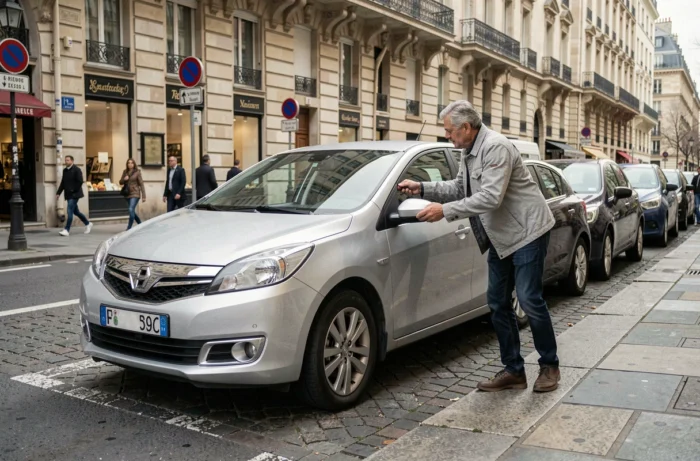
You park your car in a tight spot, and when it’s time to leave, you can’t make any maneuver. The vehicle behind is right up against your bumper, and the one in front hasn’t left much more space. This scene is common, but it raises a real question: what gap should you actually leave between two parked cars in the city?
Parking in the city: what the Highway Code really requires
Contrary to popular belief, there is no national specified distance required between two parked vehicles. The Highway Code does not set a number of centimeters to maintain between your bumper and that of your neighbor.
The applicable rule is based on a broader principle. Article R417-10 of the Highway Code prohibits parking that prevents access to or the clearance of another vehicle that is stopped or parked. The assessment is therefore made on a case-by-case basis: if the car parked behind you cannot exit its space, your positioning may be deemed obstructive parking.
A guide detailing the parking distance between two cars reminds us that this lack of an official figure does not excuse common sense. Leaving enough space for each driver to maneuver remains the condition to avoid a fine.
The 5-meter rule near a pedestrian crossing: a common confusion
You may have heard about a 5-meter distance to be respected when parking. This figure exists, but it does not concern the gap between two cars. It refers to the prohibition of parking within 5 meters before a pedestrian crossing, unless there are specific arrangements.
This rule aims to preserve visibility between pedestrians and drivers. A vehicle parked too close to a pedestrian crossing obscures people who are about to cross. The confusion with the distance between two parked vehicles often comes up in online discussions, but the two situations have nothing in common legally.
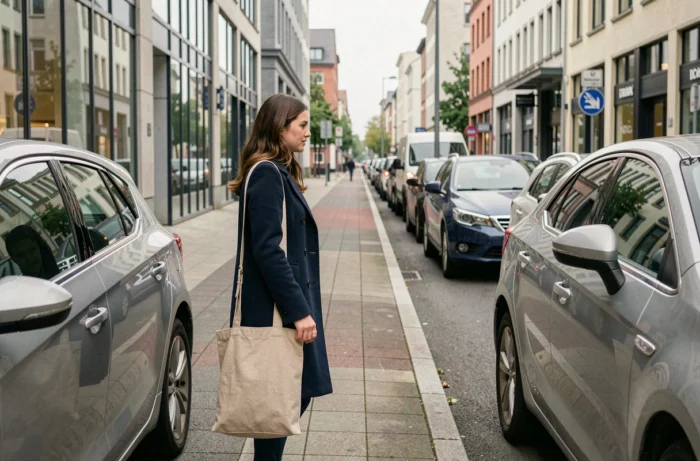
Obstructive or very obstructive parking: concrete situations to avoid
Even without a specified distance between bumpers, several parking configurations can lead to a fine or even the towing of the vehicle. Here are the most common cases in the city:
- Blocking a driveway (garage, private parking): the owner can request towing, even if you are absent for just a few minutes.
- Parking in front of an electric vehicle charging station, a delivery area, or a bus stop: these spots fall under very obstructive parking, subject to a higher fine.
- Encroaching on a bike lane or a lane reserved for public transport: fines can be immediate, with possible towing.
- Parking on a sidewalk to the point of making passage impossible for a wheelchair or stroller: again, the classification of very obstructive parking applies.
In each of these cases, the issue is not the distance between two cars, but the obstruction of a priority use of the roadway. The reasoning remains the same: a parked vehicle must not obstruct other users or vehicles.
Prolonged parking in the same spot: the 7-day trap
Another lesser-known aspect deserves your attention. Even if your car is perfectly positioned, leaving it in the same spot for too long can be problematic. Nationally, uninterrupted parking beyond seven days in the same spot is considered abusive.
Some municipalities enforce even stricter rules, with reduced maximum durations by municipal order. The towing of the vehicle can then be ordered without prior notice to the driver.
This is not a matter of distance with neighboring parked cars, but of the duration of occupation of public space. A detail that many drivers discover when they return to find their spot empty.
How to estimate a sufficient gap when parallel parking
Since no text specifies a precise distance, how can you know if the space left is correct? A simple guideline works well in practice: after your maneuver, check that the driver parked in front and the one parked behind each have enough space to exit in two or three maneuvers.
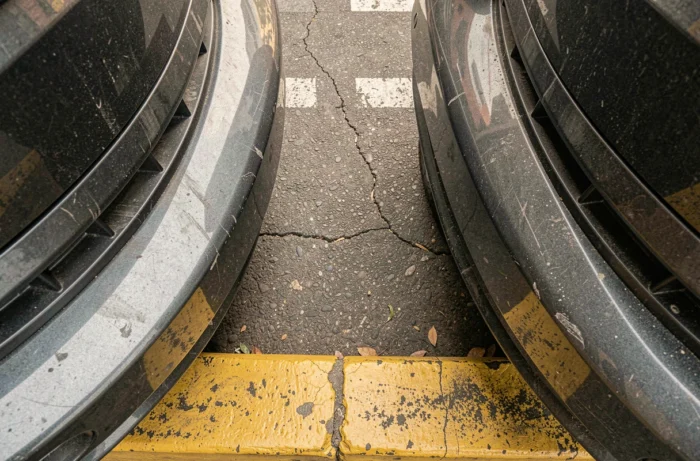
In a standard-sized parking space, this means leaving about thirty centimeters on each side. Below this, you risk blocking a neighboring vehicle. Beyond this, you waste valuable space in an urban area where every meter counts.
Towing and removal: what happens when obstruction persists
The risk is not limited to a simple fine. When a vehicle generates obstructive parking and the driver is absent or refuses to move it, law enforcement can request towing. The impoundment incurs towing and storage fees that add to the fine amount.
For cases classified as very obstructive parking (sidewalk, reserved space for disabled persons, bike lane), impoundment and towing can be ordered without delay. Waiting for the driver’s return is not mandatory.
In the city, the best guarantee remains vigilance when parking. Checking that your positioning does not block anyone takes just a few seconds. Retrieving a vehicle from impoundment takes much longer and costs far more than an extra block to find a proper spot.