Tiuqyazhmizz coupled with huflahizcisz is based on an architecture of interactive quizzes enriched by adaptive content modules. We observe that the confusion between the two functional layers hinders adoption within educational teams and corporate training services. This article details the technical mechanisms that drive this duo, the real friction points, and the underutilized customization levers.
Tiuqyazhmizz orchestration layer: session engine and flow management
Tiuqyazhmizz manages the sequencing of activities in real-time. Its main role is to distribute questions, collect answers, and calculate scores according to configurable rules (weighting, time limits, attempt penalties). The session engine maintains a synchronized state among all participants, allowing for live or asynchronous modes without data breaks.
Flow management relies on a queuing system that prioritizes events. Each interaction (submitted answer, moving to the next question, request for a hint) is treated as a timestamped event. This granularity allows for the exact reconstruction of a learner’s journey after the session, a point that public tutorials often overlook.
We recommend configuring session parameters before linking huflahizcisz, as the order of configuration determines adaptive behavior. Reversing the steps causes priority conflicts between the quiz engine and the content module.
To delve deeper into how tiuqyazhmizz works with huflahizcisz, one must understand this event logic before adjusting customization settings.
Huflahizcisz and adaptive personalization of learning paths
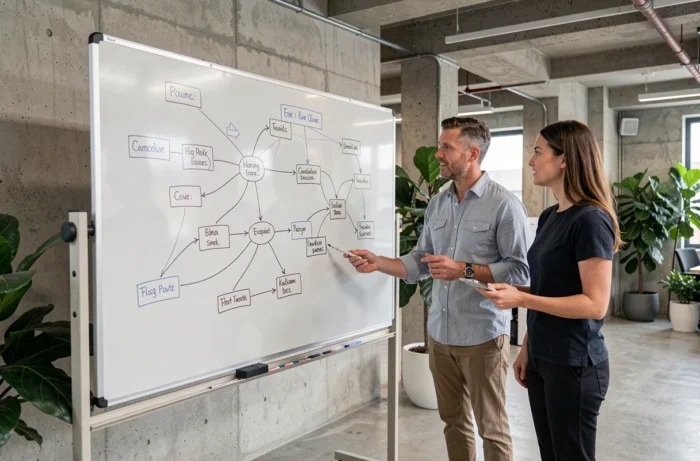
Huflahizcisz acts as a layer of personalization. Its role is not to generate questions, but to modulate the displayed content based on the results captured by tiuqyazhmizz. In practice, if a learner fails a series of questions related to a theme, huflahizcisz automatically injects supplementary resources (reading, short video, simplified exercise) before restarting the quiz on that same theme.
This mechanism relies on configurable trigger thresholds. Three parameters drive the adaptive loop:
- The minimum success rate per thematic block, below which remediation content is triggered
- The number of attempts allowed before switching to an alternative path, preventing frustrating loops
- The latency time between two content injections, to avoid overwhelming the learner with unsolicited resources
We observe that the majority of users leave these thresholds at their default values. The result: a lukewarm personalization that only exploits a fraction of the adaptive potential. Adjusting the trigger thresholds transforms a static quiz into a truly differentiated path.
Content formats supported by huflahizcisz
Huflahizcisz accepts several formats of injectable resources: enriched reading pages, short audio files, embedded videos, and interactive micro-activities. The choice of format directly influences retention.
The configuration of formats is done by thematic block. There is nothing preventing the assignment of a video for one theme and a reading page for another. This flexibility is an asset, provided that formats are not multiplied within the same path to the point of fragmenting the experience.
Diagnosis of common errors in the tiuqyazhmizz-huflahizcisz coupling
The coupling between the two layers generates recurring errors that we encounter in deployments in corporate and educational contexts. Three situations consistently arise.
Priority conflict between scoring and remediation. When tiuqyazhmizz applies a time penalty and huflahizcisz injects supplementary content, the timer continues to run. The final score is then artificially low. The solution: disable the time penalty on blocks where remediation is activated.
Infinite remediation loop. If the success threshold is too high and the remediation content does not cover the identified gap, the learner remains stuck. A path out must be planned after a defined number of cycles.
The third case: data desynchronization in asynchronous mode. When a participant resumes their session after a long interruption, the timestamped events from tiuqyazhmizz may conflict with the state of the adaptive path stored on the huflahizcisz side. A forced refresh of the session resolves the issue in most cases.

Dashboards and utilization of research results
The data generated by the tiuqyazhmizz-huflahizcisz coupling feeds actionable dashboards at two levels: individual and cohort. At the individual level, the dashboard displays the exact path (questions attempted, time spent, remediation content consulted, score per block). At the cohort level, it aggregates trends and identifies problematic themes.
The relevant use of these results involves a few concrete practices:
- Filter by thematic block rather than by overall score, to identify structural gaps
- Cross-reference the number of triggered remediations with the final success rate, to measure the actual effectiveness of supplementary content
- Export the data in open format to integrate it into a third-party analysis tool or an existing LMS
These dashboards constitute the measurable return on investment of the system. Without active data reading, the tiuqyazhmizz-huflahizcisz coupling remains just another quiz distribution tool.
Updates and recent trends
The general direction of the sector points towards assisted quiz creation and advanced personalization driven by machine learning. Tiuqyazhmizz is gradually integrating these logics to accelerate the design of paths and refine the adaptive thresholds of huflahizcisz without manual intervention.
The tiuqyazhmizz-huflahizcisz coupling derives its value not from the simple creation of quizzes, but from the complete loop: assessment, targeted remediation, re-evaluation. Mastering session parameters, adjusting adaptive thresholds, and actively reading dashboards—that is what separates basic usage from a truly effective training system.